



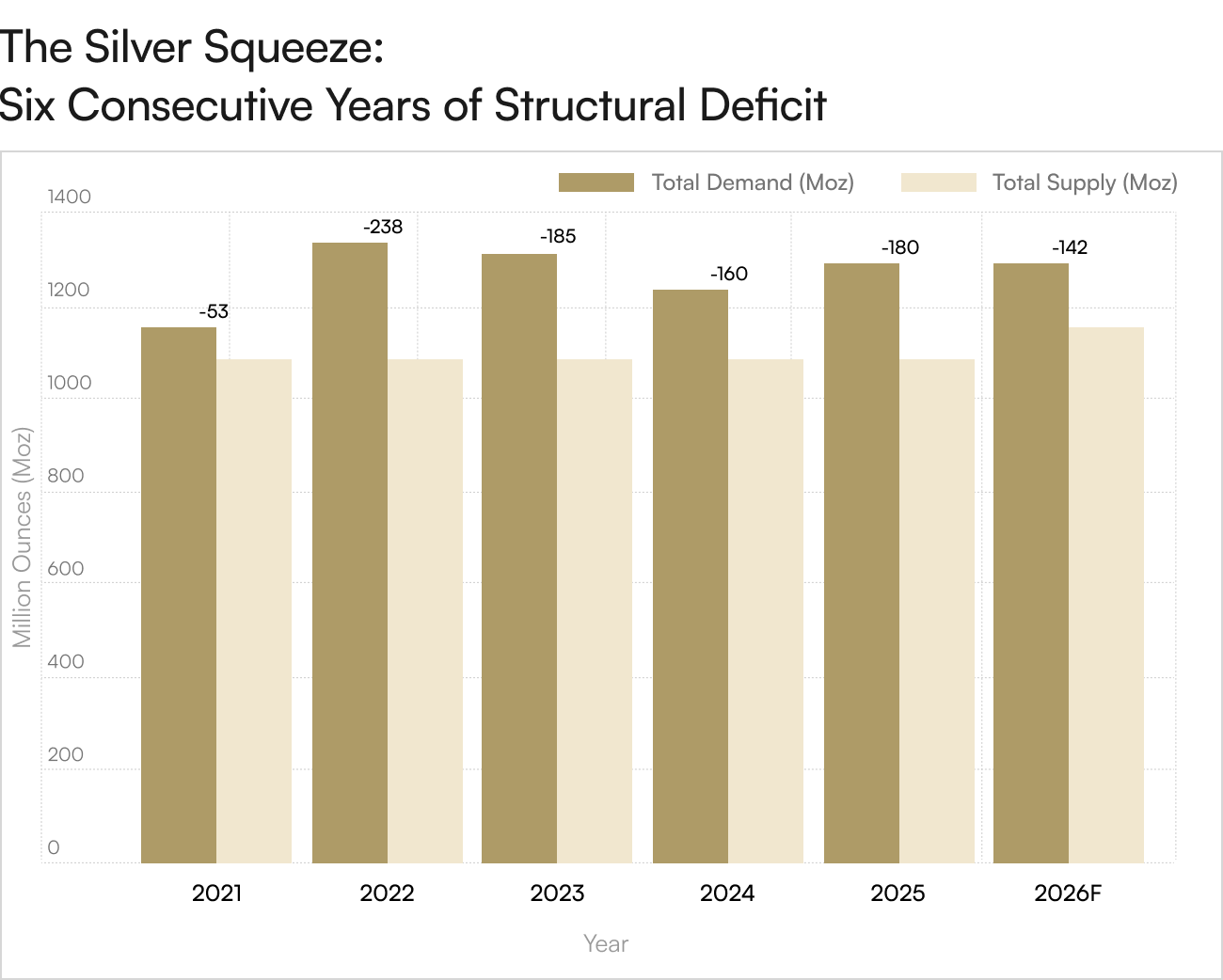
Silver has spent most of the last two years living in gold's shadow, but the metal's underlying market is telling a very different story. According to the latest figures from the Silver Institute, the global silver market is on track for a sixth consecutive year of structural deficit in 2026, with shortfall estimates running near 67 million ounces. For long-term investors, that figure is far more revealing than any single weekly price move.
A Market Built on Two Different Demands
Unlike gold, silver answers to two masters. About sixty percent of annual demand comes from industry, with photovoltaic solar cells, electric vehicles, electronics, and AI infrastructure all requiring the metal in growing quantities. The other forty percent is investment demand — bars, coins, ETPs, and central banks dipping in cautiously. When both sides pull at the same time, prices have historically moved with force.
That dual character is precisely why analysts at the Silver Institute and Metals Focus expect bar and coin demand to climb roughly twenty percent in 2026, even as solar manufacturers thrift the metal out of their cell designs. Western buyers, after several years of net redemptions, have rotated back into physical silver as a cheaper alternative to record-priced gold.
The Mining Math Working Against Supply
Silver supply is famously inelastic. Roughly seventy to eighty percent of mined silver comes as a byproduct of base-metal operations — copper, lead, and zinc mines that are economically driven by base-metal prices, not silver. Even with silver trading at multi-decade highs, miners cannot simply turn on the taps. New primary silver projects take years to permit and build, and ore grades at existing mines have been declining for over a decade.
Recycling helps at the margin, but global scrap reached a thirteen-year high in 2025 and still left the market with a shortfall. Without a meaningful new source of supply, every additional ounce of demand competes for an already-rationed pool.
“The structural deficit isn't a forecast at this point — it's a description of reality. The market has been short for five years and the reasons it's short keep multiplying.” — Silver Institute outlook commentary, Q1 2026
Why Investors Are Treating Silver Differently in 2026
After silver briefly cleared the psychologically important $100 per ounce mark in early 2026, several institutional voices that had previously been skeptical began revising their forecasts upward. J.P. Morgan now projects silver averaging $81 per ounce on the year, more than double the 2025 average. Other research desks have higher targets that depend on the pace of Federal Reserve rate cuts and the trajectory of the U.S. dollar.
For private investors, the case for owning physical silver is increasingly straightforward. The metal offers a smaller entry price than gold, real industrial floor demand that gold lacks, and a gold-to-silver ratio that has historically reverted lower during extended precious-metals bull markets. Owning bars and rounds avoids counterparty risk, storage fees on ETFs, and the kind of physical-supply tightness that has produced visible squeezes in London and on COMEX over the last twelve months.
What Could Change the Picture
No thesis is bulletproof. A faster-than-expected substitution away from silver in solar cells — toward copper plating or thin-film cadmium telluride — would soften industrial demand. A sharp recession could compress short-term industrial use as well. Conversely, a continuation of the AI infrastructure build-out, sustained EV adoption, and any meaningful Fed easing cycle would all reinforce the existing setup.
Either way, structural deficits do not resolve themselves. They tend to be resolved either by a price strong enough to incentivize new mine development — which then takes a decade to come online — or by a demand shock that briefly rebalances the equation.
The Bottom Line for Investors. Investors who treat silver as a permanent allocation rather than a trade have historically been the ones rewarded across full cycles. If you are weighing how a measured silver position might fit your retirement plan, brokerage portfolio, or generational wealth strategy, speak with a Merchant Gold Group precious metals specialist to walk through bar, coin, and IRA-eligible options on your terms.




