



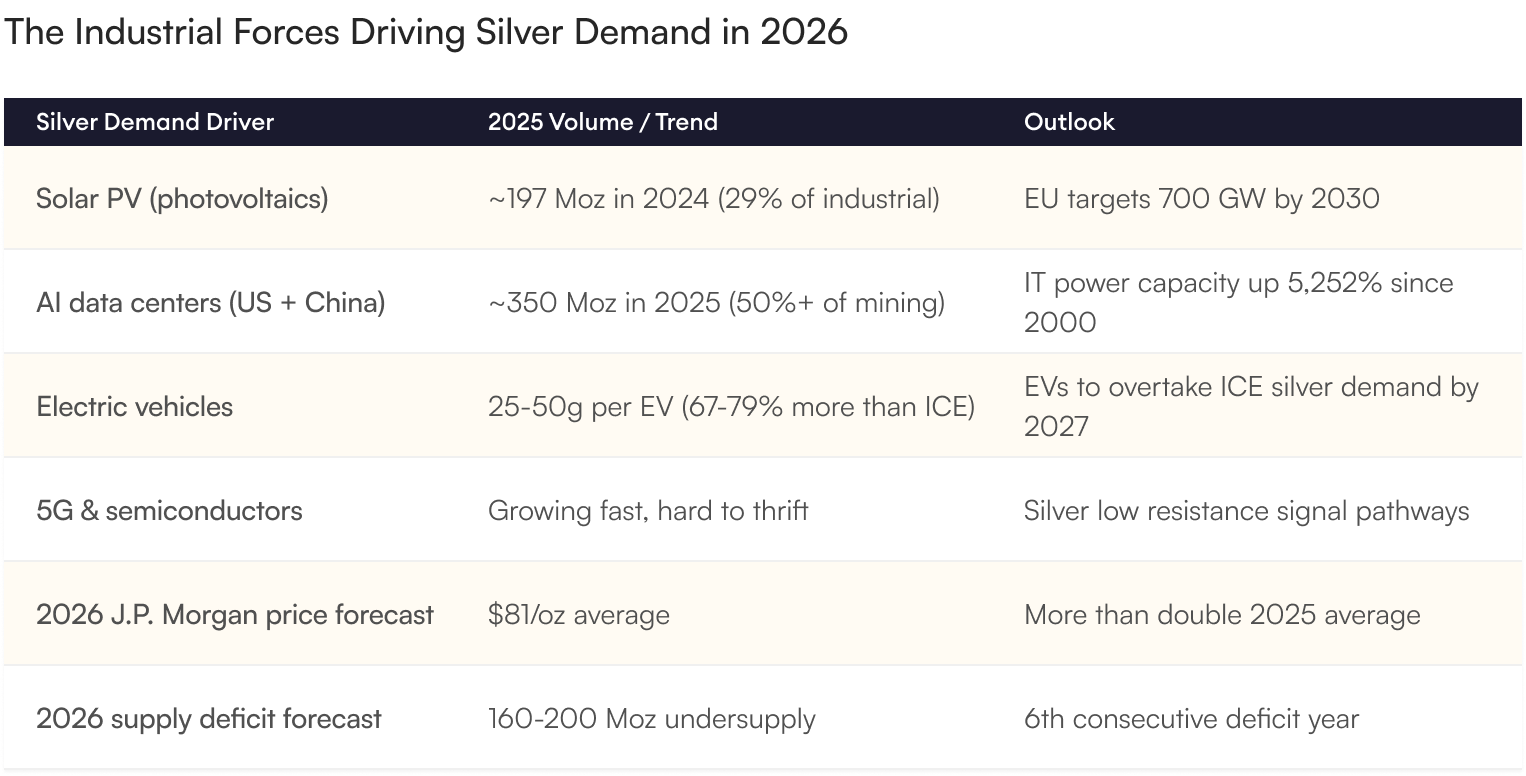
Most retail investors still think of silver as gold's cheaper cousin, a monetary metal that moves when the dollar weakens. That framing is now fifteen years out of date. According to the Silver Institute, more than half of annual silver demand is now industrial, and the single fastest growing slice is something that did not exist as a meaningful category ten years ago. AI data centers. The United States and China alone consumed an estimated 350 million ounces of silver in 2025 for data center hardware, exceeding 50 percent of global mining supply from a single end market. With the International Energy Agency projecting global electricity demand from data centers, AI, and crypto to double by 2026, the demand floor under silver is now structural, not cyclical, and miners cannot meaningfully respond. Silver supply is largely a byproduct of copper, zinc, and lead mining, which means silver production decisions are made on base metal economics rather than silver prices.
The Demand Driver Gold Does Not Have
Roughly 50 to 55 percent of annual silver demand comes from industrial applications, according to Silver Institute data. Gold's industrial demand is effectively zero. Gold serves almost exclusively as a monetary asset and store of value. Silver is both, and it is also a critical input for some of the largest capital spending cycles in the global economy right now. Solar is the most significant. Each standard solar panel uses approximately 20 grams of silver in its electrical contacts, and global solar installations have been growing at 25 to 30 percent per year. The IEA projects solar capacity additions exceeding 500 gigawatts in 2026, which translates to more than 100 million ounces of silver demand from solar alone, approximately 10 percent of global annual supply from one end market.
Supply Cannot Respond
This is the part of the story most retail commentary misses. Silver mining cannot ramp the way oil drilling can. Most silver comes out of the ground as a byproduct of copper, zinc, or lead mining, which means production volumes are governed by base metal economics rather than silver prices. A 50 percent rise in the silver price does not produce a 50 percent rise in silver mine output. It produces, at best, a few percent rise over many years as new primary silver projects work through permitting and capital allocation. China tightened silver export licenses starting January 2026, further constraining global physical supply. Recycling and secondary supply are growing slowly. The result is a market that has been in structural deficit since 2021, with cumulative inventory drawdown approaching 700 million ounces. Industrial buyers who cannot substitute away from silver, mostly solar manufacturers and electronics, increasingly compete with investors for a shrinking physical pool.
The Volatility Caveat for Retirement Allocations
Silver has historically traded at 1.3 to 1.5 times the volatility of gold. It fell more sharply during the 2022 risk off period and recovered more aggressively through 2023 to 2025. For investors who held through that full cycle, the rewards were significant. For investors who panicked at drawdowns, the experience was painful. Position sizing matters. For a typical retirement portfolio, the case for silver is not to replace gold but to complement it. Gold provides the monetary debasement hedge. Silver provides the same hedge plus exposure to the secular industrial cycle. A balanced precious metals sleeve weighted approximately two thirds gold and one third silver captures both demand engines while keeping volatility in check.
Position Before Industrial Demand Outpaces Supply
Silver IRA eligible products include American Silver Eagles, Canadian Silver Maple Leafs, and .999 fine silver bars from approved refiners. The same self directed IRA structure that holds gold can hold silver, with no additional tax complication. Merchant Gold Group offers a full range of IRA eligible silver bullion, expert allocation guidance based on your current portfolio, and a transparent premium structure that reflects current market conditions rather than hidden markups. Contact our specialists today to add a structurally undersupplied industrial metal to your retirement portfolio at a moment when sovereign demand, industrial demand, and investment demand are converging on the same physical pool.




