


While the financial media remains hyper-focused on fluctuating equity indexes and escalating overseas military conflicts, a highly destructive, slow-motion crisis is unwinding within the domestic United States economy. The commercial real estate (CRE) sector is currently experiencing a structural collapse, driven by a permanent societal shift toward hybrid work environments and an exceedingly punitive interest rate regime. As office vacancy rates shatter historical records, the resulting financial contagion is quietly threatening the stability of the regional banking sector and the standard retirement portfolios inherently tied to it.
The Commercial Vacancy Crisis
According to comprehensive 2026 data from industry monitors like CoStar Group and Jones Lang LaSalle (JLL), the national office vacancy rate has surged to an unprecedented 19.1%. The devastation is highly concentrated in major metropolitan hubs, representing trillions of dollars in rapidly depreciating asset value.
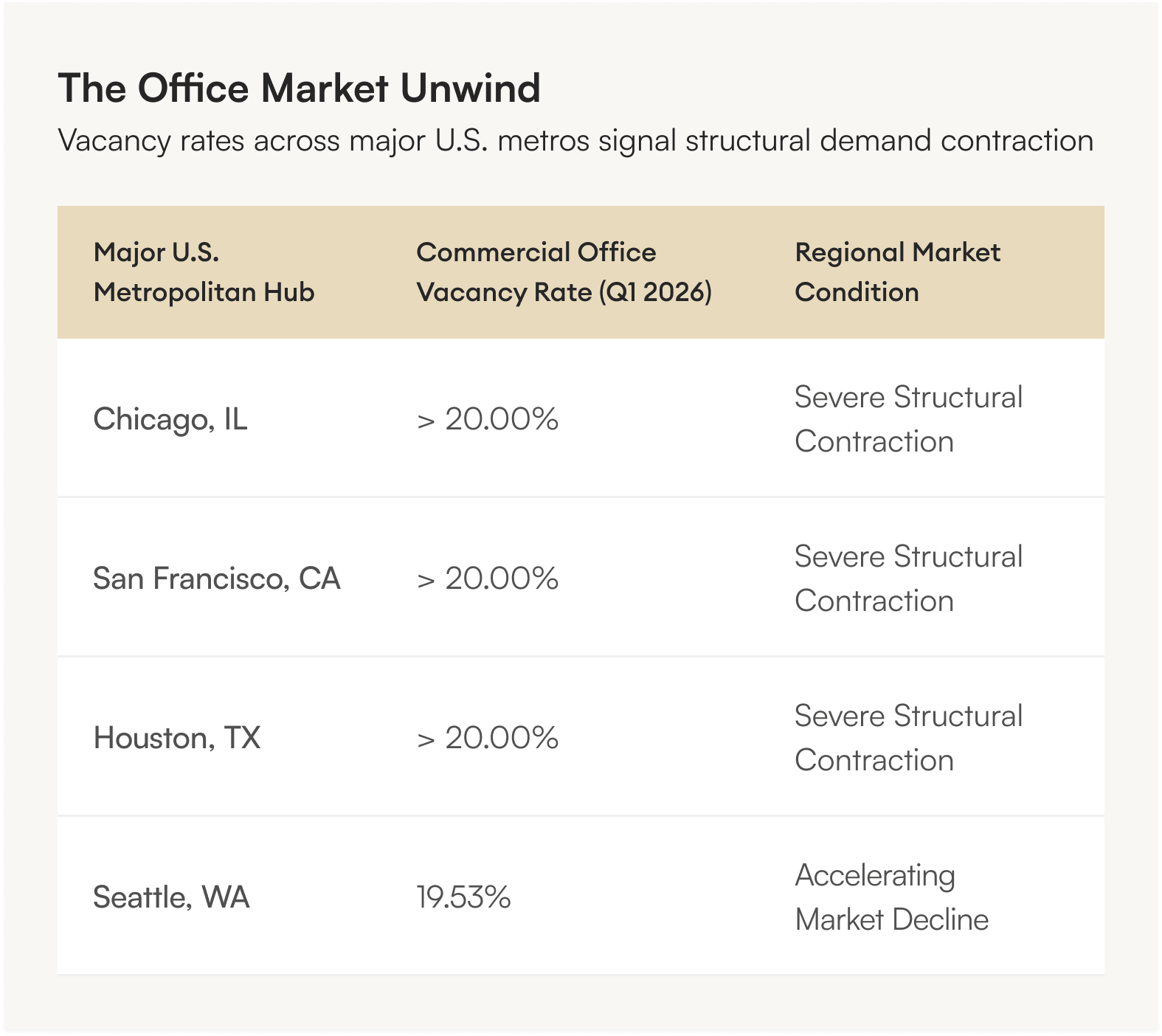
This unprecedented level of empty commercial space triggers a cascading economic failure. Property owners, entirely unable to generate sufficient rental income to service their massive, variable-rate commercial mortgages, are strategically defaulting on their obligations. Regional and mid-sized banks, which hold the vast majority of these commercial real estate loans, are rapidly approaching a threshold where they must foreclose on underwater properties to clear the debt from their balance sheets. By taking possession of these severely devalued assets, regional banks are forced to absorb devastating write-downs, directly threatening their institutional solvency and restricting their ability to lend to small businesses.
Contagion in the Regional Banking Sector
The broader implications of this CRE collapse extend far beyond the localized banking sector. As commercial property values plummet, municipal tax revenues—which rely heavily on commercial real estate assessments—are severely degraded. Cities are forced to cut critical civic services while simultaneously raising residential property taxes to bridge the fiscal gap, further strangling the American consumer's purchasing power.
In this toxic environment, traditional 60/40 investment portfolios face a dual-front assault. The equity portion is threatened by impending regional bank failures and the broader economic slowdown, while the bond portion remains heavily degraded by persistent inflation. This highly correlated risk requires investors to seek immediate shelter in assets completely detached from the credit cycle, commercial debt markets, and banking sector vulnerabilities.
The Tangible Safe Haven Strategy
Physical gold and silver serve as the ultimate non-correlated safe haven. Because precious metals possess zero counterparty risk and are not dependent on rental yields, municipal tax stability, or banking sector solvency, they consistently thrive during periods of credit contraction and systemic financial stress. Reallocating vulnerable capital into a self-directed Precious Metals IRA with Merchant Gold Group guarantees that a portion of your wealth remains permanently insulated from the impending wave of commercial defaults. Reach out to our dedicated specialists today to fortify your retirement against the silent collapse of the commercial real estate market.




