


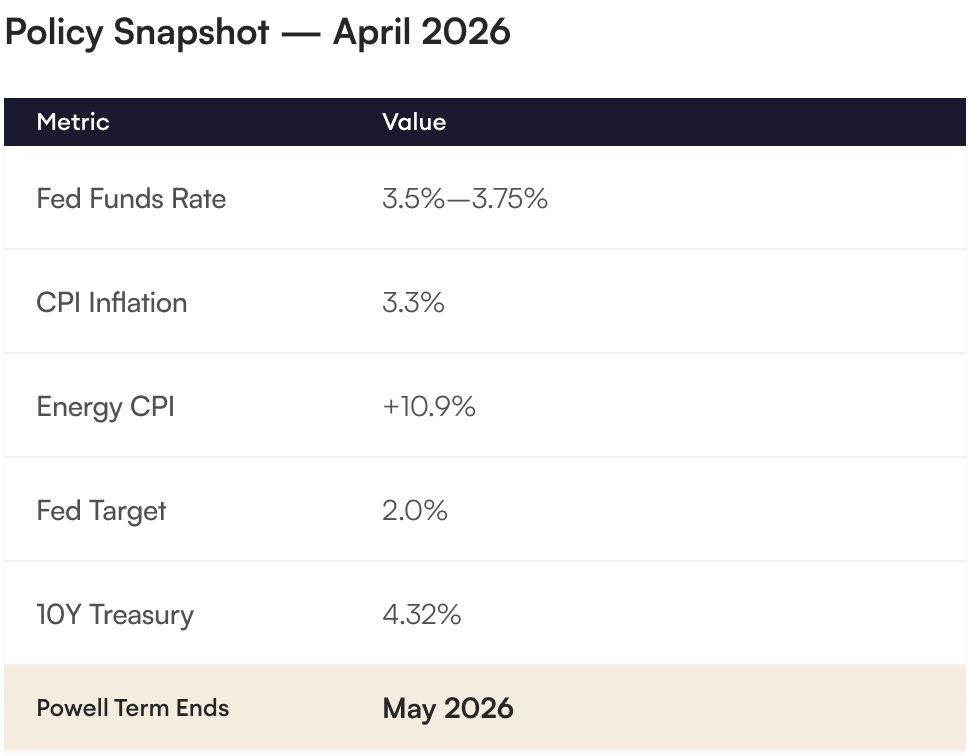
Federal Reserve Chairman Jerome Powell's term expires in May 2026, creating a critical moment of uncertainty for U.S. monetary policy at a time when inflation remains stubbornly above the central bank's 2% target. March 2026 CPI data showed consumer prices rising 3.3% year over year, driven by a 10.9% surge in energy costs related to the Iran war. The Fed has held interest rates steady at 3.5% to 3.75% for two consecutive meetings, signaling only one potential rate cut in 2026 and another in 2027. With a new Fed Chair likely to be named in the coming weeks, markets face the dual challenge of elevated inflation and policy leadership transition, a combination that historically drives capital toward safe haven assets like gold.
The Inflation Problem
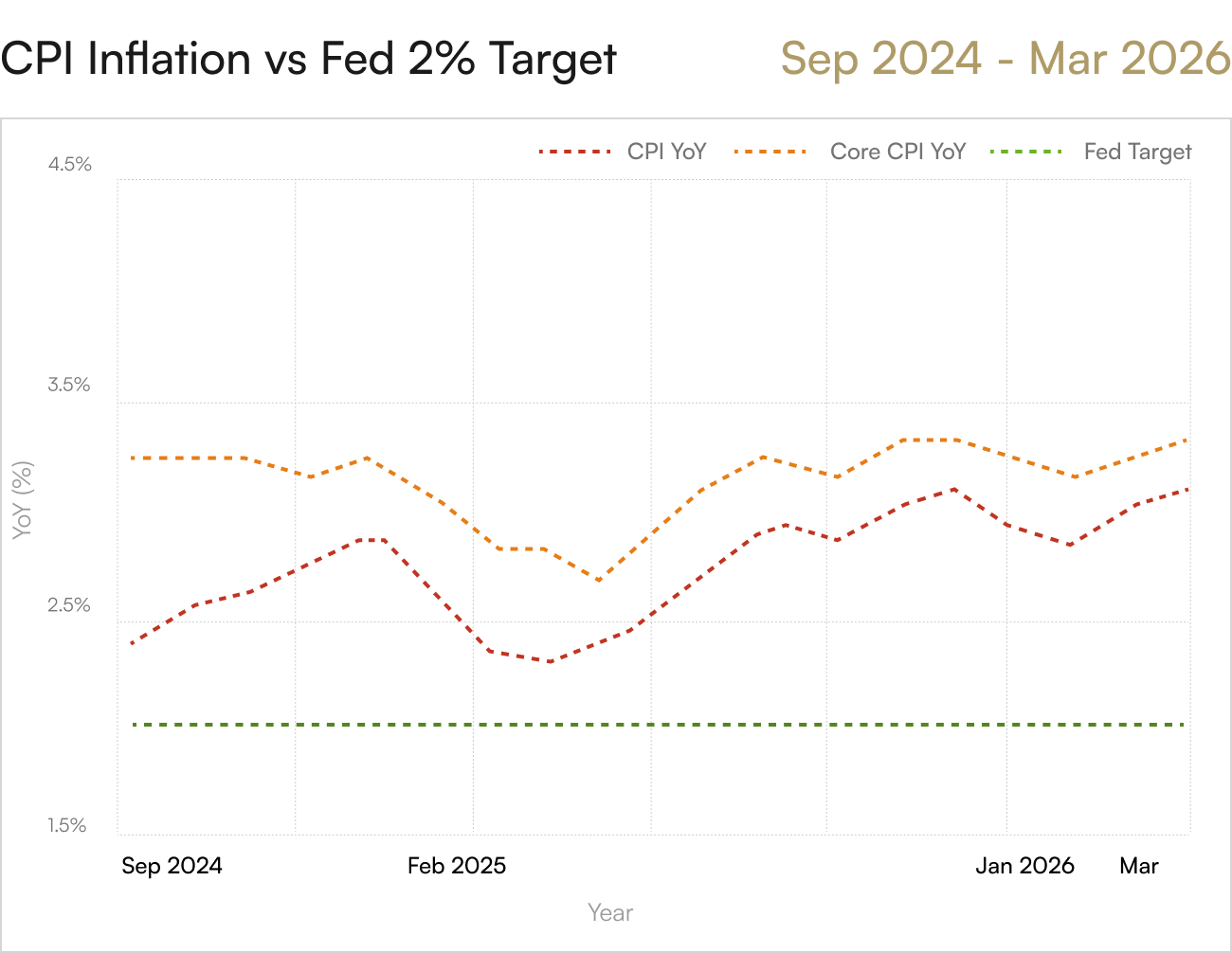
Despite 175 basis points of rate cuts since September 2024, inflation has proven far more persistent than the Federal Reserve anticipated. The latest CPI report for March 2026 came in at 0.9% month over month and 3.3% year over year. Core inflation, which excludes volatile food and energy prices, also remains elevated. The Fed's own projections now expect both headline PCE and core PCE inflation to reach 2.7% in 2026, revised upward from earlier forecasts of 2.4% to 2.5%. Energy prices have been the primary culprit, but inflation is showing stickiness across shelter, services, and core goods categories as well.

Leadership Transition and Policy Risk
Jerome Powell's term as Fed Chair expires in May 2026, and the incoming administration will appoint his successor. This transition introduces significant policy uncertainty. Different candidates bring different philosophies on inflation targeting, balance sheet management, and the appropriate level of the neutral interest rate. While the Fed has maintained an independent stance under Powell, political pressure for lower rates has intensified, particularly from those seeking relief on mortgage costs and Treasury borrowing expenses. A new Chair closely aligned with political desires for easier monetary policy could signal a dovish shift, potentially reigniting inflation and undermining the dollar. Conversely, a hawkish appointment could extend the higher for longer rate environment, increasing recession risks.
Market Implications
Professional forecasters widely expect the Fed to keep rates steady for the foreseeable future given persistent inflation. The 10 year Treasury yield remains elevated near 4.32%, reflecting market concerns about fiscal deficits, inflation persistence, and policy uncertainty. Real yields, after adjusting for inflation expectations, are barely positive. This creates a challenging environment for traditional fixed income investors who face reinvestment risk, duration risk, and purchasing power erosion simultaneously. Equity markets, meanwhile, are trading at elevated valuations above 20x forward earnings while facing potential margin compression if inflation forces the Fed to reverse course and hike rates again.
.png)
Gold as the Consistent Winner
Gold thrives in exactly this type of environment. When real interest rates are low or negative, the opportunity cost of holding non yielding gold is minimal. When inflation runs above the Fed's target, gold preserves purchasing power as fiat currency devalues. When monetary policy uncertainty rises due to leadership transitions, gold benefits from safe haven flows. When geopolitical risks keep energy prices elevated, gold acts as a hedge against economic instability. Gold is currently trading near $4,700 per ounce, up approximately 50% year over year, because institutional and retail investors recognize that the Fed is trapped between persistent inflation and slowing economic growth, the exact definition of stagflation.
Protect Your Retirement from Policy Risk
Retirement portfolios built on the assumption of stable monetary policy and predictable inflation are facing a moment of truth. With Powell's departure in May, the Fed could shift toward easier policy to accommodate political pressure, risking a reacceleration of inflation. Or it could maintain restrictive policy longer than markets expect, risking recession. Either scenario is negative for traditional stocks and bonds. Physical gold and precious metals held in a self directed IRA offer protection that does not depend on any central bank's credibility, any politician's promises, or any economist's forecast. Gold is the one asset that cannot be printed, debased, or politically manipulated. Contact Merchant Gold Group today to learn how to insulate your retirement savings from Federal Reserve policy uncertainty before the leadership transition creates the next market shock.




