


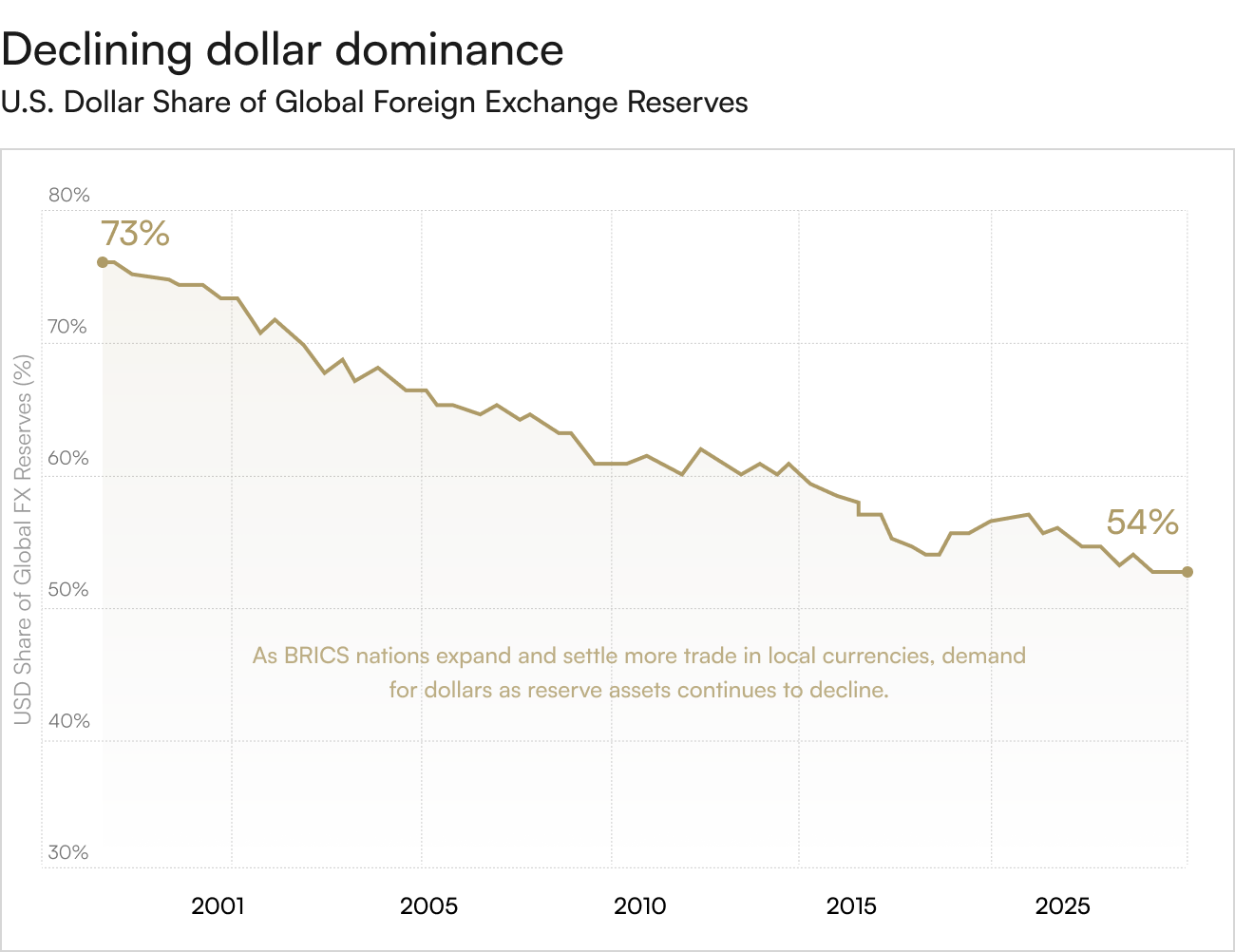
The most significant shift in global monetary architecture since the Bretton Woods system is happening right now, and most American retirement investors are completely unaware of it. Russia and China have effectively decoupled from the U.S. dollar, settling approximately 90% of their bilateral trade in rubles and yuan. The BRICS bloc, which now represents nearly 40% of global GDP measured by purchasing power parity, is systematically constructing alternative payment infrastructure through systems like mBridge and BRICS Pay that bypass dollar intermediation entirely. The dollar's share of global foreign exchange reserves has fallen from 73% in 2001 to approximately 54% in 2025, and this decline is accelerating. For retirement portfolios denominated in dollars, the implications are profound: the currency you are saving in is losing its privileged status as the world's reserve asset, and gold is emerging as the ultimate beneficiary.
The Russia-China Blueprint
Following Western sanctions imposed after geopolitical conflicts, Russia was effectively cut off from the SWIFT international payment system and had hundreds of billions in dollar denominated reserves frozen. This weaponization of the dollar sent a clear message to non aligned nations: reliance on the U.S. financial system creates existential vulnerability. Russia and China responded by developing bilateral settlement mechanisms in their own currencies. Today, approximately 90% of trade between the two nations is conducted in rubles and yuan, completely bypassing the dollar. Russian President Vladimir Putin stated at a recent forum that Russia is not fighting the dollar, but if denied access to it, alternatives must be created. China has provided that alternative.
The Infrastructure of De-Dollarization
BRICS nations are not merely talking about de-dollarization; they are building the plumbing. The mBridge system enables instant payments between central banks in China, Hong Kong, Thailand, and the United Arab Emirates using digital national currencies, eliminating dollar intermediation. BRICS Pay is a payment card system allowing consumers in member countries to transact directly in local currencies. The New Development Bank, established by BRICS, has set a target of conducting 30% of its lending in local currencies of member nations by 2026, up from minimal levels just a few years ago. Russia's Deputy Foreign Minister confirmed that the de-dollarization agenda would take center stage at BRICS summits. These are not aspirational statements; they are operational realities already functioning at scale.
The Dollar Privilege Is Ending
For decades, the United States benefited from dollar hegemony: the ability to print the world's reserve currency, borrow at artificially low rates, and export inflation to other nations. That privilege is eroding. As BRICS and other nations settle trade in local currencies, global demand for dollars declines. Reduced demand means reduced pricing power. Reduced pricing power means higher borrowing costs for the U.S. government and downward pressure on the dollar's purchasing power. A study analyzing BRICSIZATION from 2003 to 2022 found that the average independence from the dollar index exceeded 72%, with currencies of Brazil, China, and South Africa averaging 93%, indicating these nations are already well positioned to function in a post dollar world.
Political Threats Accelerate the Trend
President Trump threatened to impose 100% tariffs on BRICS countries that pursue de-dollarization efforts. Brazilian President Lula da Silva responded at an emergency summit in September 2025, characterizing tariff blackmail as a tool to capture markets and meddle in internal politics. Far from deterring BRICS, these threats have accelerated their determination to build parallel systems. India's External Affairs Minister clarified that while India has no policy to replace the dollar, the bloc's expansion and infrastructure development continue unabated. The 2025 BRICS Summit Joint Declaration noted serious concerns about the rise of unilateral tariff measures, signaling unified resistance to dollar coercion.
Gold: The Universal Reserve Asset
As the dollar's dominance wanes, what replaces it? Not the euro, which faces its own structural challenges. Not the yuan, which lacks full convertibility and remains subject to Chinese capital controls. The answer is gold. Gold is the only asset that is universally accepted, immune to sanctions, free from counterparty risk, and outside the control of any single nation's central bank. This is why central banks purchased approximately 863 tonnes of gold in 2025 and are projected to buy 755 tonnes in 2026. This is why 95% of central banks surveyed plan to increase their gold reserves. This is why gold's share of global reserves is at the highest level since 1991 while the dollar's share is at the lowest since 1994. De-dollarization is not a theoretical future event; it is the structural driver pushing gold toward $5,000, $6,000, and beyond.
Protect Your Wealth from Currency Debasement
American retirement investors holding 100% of their wealth in dollar denominated assets are making an unhedged bet on the continued dominance of a currency that is systematically losing its reserve status. As BRICS nations representing 40% of global GDP build payment systems that exclude the dollar, and as central banks accumulate gold at the fastest pace in modern history, the message is unmistakable: the dollar era is ending, and precious metals are the insurance policy. Physical gold held in a self directed IRA or personal possession does not depend on dollar hegemony, SWIFT access, or geopolitical goodwill. It is wealth that exists outside the fiat monetary system entirely. Contact Merchant Gold Group today to learn how to position your retirement portfolio for a world where the dollar is no longer king and gold reclaims its ancient role as the ultimate store of value.




