



For nearly eight decades, the absolute foundation of Western economic supremacy has been the undisputed hegemony of the United States dollar in global trade settlement. However, the geopolitical landscape of 2026 has witnessed the crystallization of a highly organized, heavily capitalized alternative. As the BRICS consortium rapidly expands its membership and global influence—spearheaded by India's leadership at the 2026 Summit—the coalition is moving decisively to shatter the dollar's monopoly through the implementation of a revolutionary financial mechanism: a gold-backed trade settlement framework known as the "Unit".
The "Unit" as a Dollar Alternative
Mainstream financial commentary in the United States often dismisses de-dollarization as a distant, purely theoretical concept. Yet, the introduction of the BRICS Unit transitions this threat from academic theory to immediate macroeconomic reality.13 Unlike traditional fiat currencies that rely entirely on central bank promises and infinite sovereign debt issuance, the Unit is mathematically tethered to physical gold and a basket of member currencies.
The implications of this structural shift in global finance are incredibly profound. Historically, gold has served as a passive reserve asset, securely vaulted by central banks merely to project national solvency and stability. The introduction of the Unit fundamentally alters this paradigm by transforming physical gold into an active, high-velocity trade asset utilized for daily, cross-border settlements between member nations.
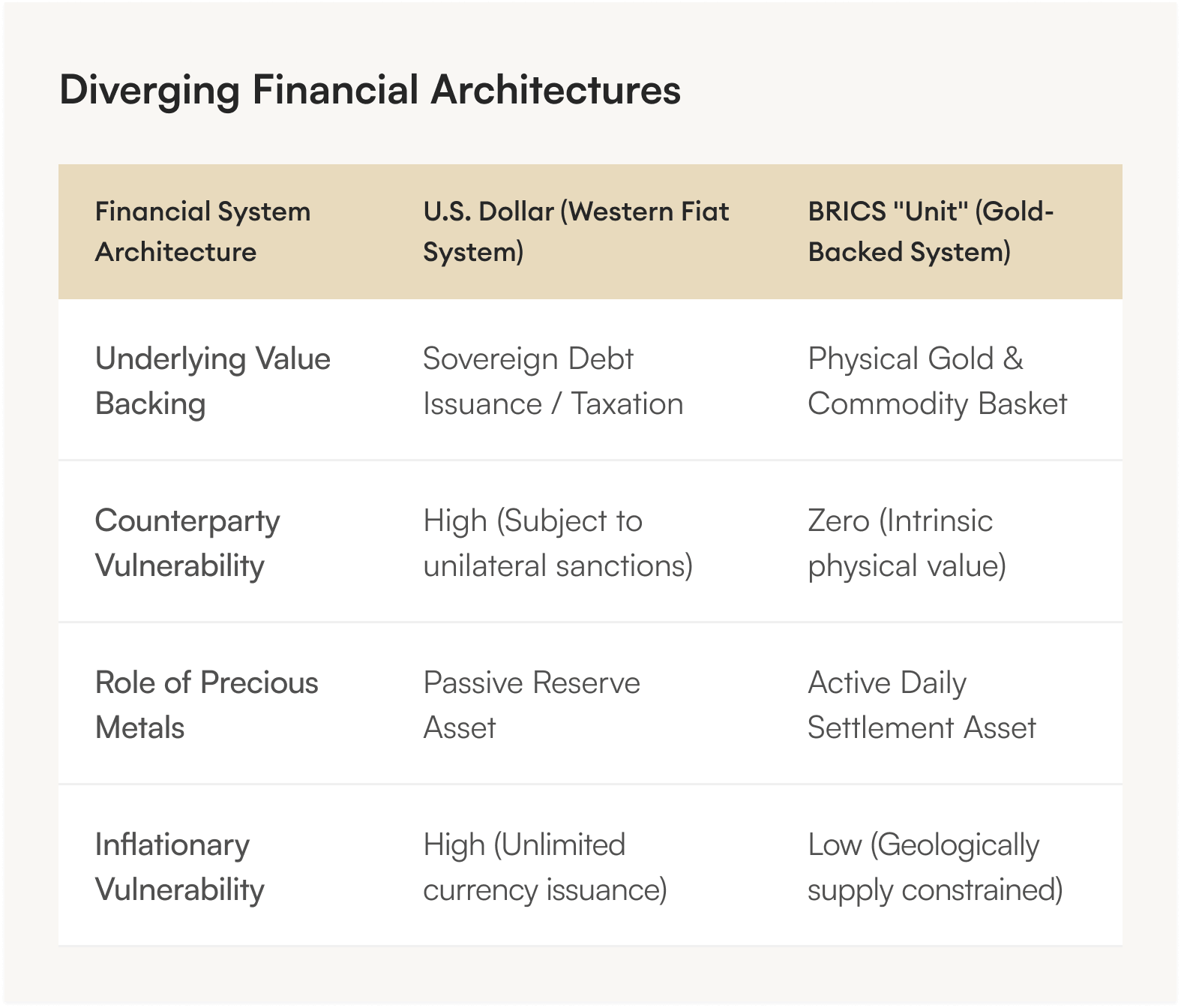
Shifting Gold from Passive to Active
By anchoring international trade to a tangible asset, the BRICS coalition effectively immunizes its economies from Western financial sanctions and the forced export of U.S. domestic inflation. Because the issuance of new Units requires member states to hold corresponding physical reserves, the framework guarantees a continuous, massive demand channel for global gold acquisition. As the BRICS bloc, which now controls a dominant share of global energy and commodity exports, mandates settlement in gold-backed instruments, the U.S. dollar's global reserve share—which has already precipitously declined from 71% in 1999 to roughly 57% in 2025—will face accelerated erosion.
The secondary economic effects of this transition for the American consumer are severe. A sustained reduction in international demand for the U.S. dollar guarantees lower foreign absorption of U.S. Treasury bonds. Consequently, the Federal Reserve will be mathematically forced to monetize a much larger portion of the national deficit, sparking a prolonged, systemic cycle of domestic inflation.6 As the dollar depreciates against hard assets, the cost of imported consumer goods, technology, and energy will surge aggressively.
Insulating Your Portfolio from De-Dollarization
Investors seeking to preserve their purchasing power must proactively adapt their portfolios to reflect this new multipolar reality. By integrating physical gold and silver into your wealth strategy, you directly align your assets with the identical monetary instruments currently being hoarded by the world’s fastest-growing economies. Merchant Gold Group provides a seamless, highly secure avenue for individuals to acquire physical bullion, shielding their retirement savings from the fallout of rapid de-dollarization. Contact our specialists today to explore how you can secure your financial sovereignty in the new era of gold-backed international trade.




