


Required Minimum Distributions are the moment when the federal tax code finally catches up with decades of tax-deferred compounding. For account holders born in 1951 or later, the first RMD is due by April 1 of the year after they turn 73, with every subsequent RMD due by December 31. The penalty for missing the deadline is among the harshest in the entire tax code: 25% of the shortfall, reduced to 10% if corrected promptly. The IRS, having waived enforcement of inherited-IRA annual-RMD requirements from 2021 through 2024, has now made clear that it intends to enforce the RMD regime as written. The 2026 distribution season is the first under the new enforcement posture and it deserves more strategic attention than most retirees give it.

How the Numbers Scale With Age
The IRS Uniform Lifetime Table produces a divisor that shrinks each year, which is what forces an ever-larger share of an IRA balance out the door as the account holder ages. The architecture is deliberate: the table assumes a gradually shorter remaining life expectancy and is designed to ensure the balance is substantially distributed before the original owner's death. The practical consequence is that retirees in their late seventies and early eighties face distribution requirements that are dramatically larger as a percentage of the balance than the requirements they faced in their early seventies.
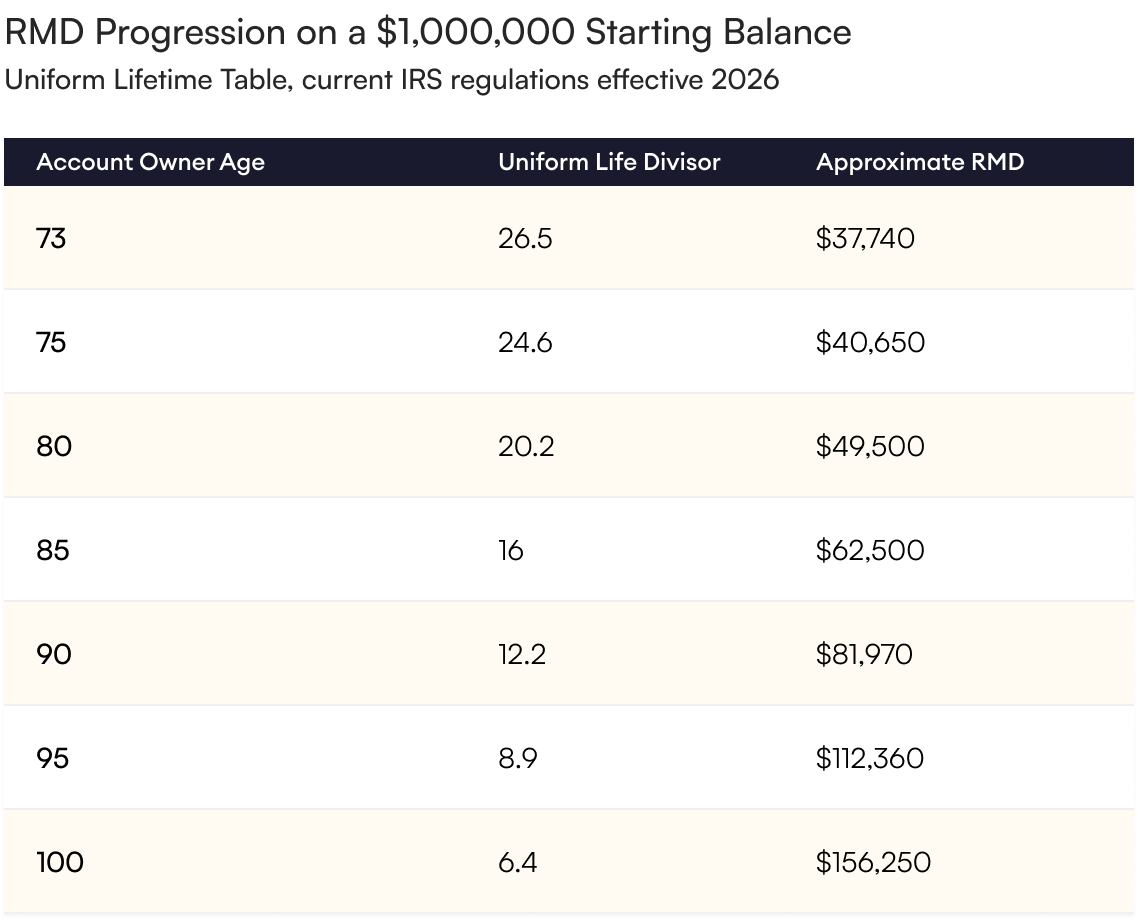
Why 2026 Is a Particularly Difficult Year to Distribute
The RMD architecture does not care about market conditions. The same divisor applies whether equities are at all-time highs or in a 25% drawdown, whether bond yields are providing real returns or eroding purchasing power, whether the dollar is strong or weak. In 2026, that asymmetry has rarely been more uncomfortable. Three macro facts make this year's distribution decisions unusually consequential.
First, inflation remains stubborn. April 2026 headline CPI printed at 3.8% — above forecast — driven by an energy shock tied to Middle East tensions and lingering shelter-cost pressure. Real wages turned negative for the first time since April 2023. Second, the 10-year Treasury yield sits at approximately 4.32% despite a series of Fed rate cuts in late 2025, meaning bond proceeds offer thin real returns after federal and state tax. Third, equity concentration risk is at a generational extreme, with the Magnificent Seven accounting for 35% of the S&P 500. Distributing in this environment frequently means crystallizing tax liability on positions that should ideally be held — or selling at the precisely wrong moment in the cycle.

The Self-Directed Gold IRA Redirect
The structure many forward-looking retirees have been using throughout 2025 and into 2026 works as follows. After taking the RMD from a traditional IRA (and paying the ordinary-income tax owed on it), the after-tax proceeds can be redirected into a taxable physical-gold holding outside the IRA system entirely, or — where contribution-eligibility rules permit — used to fund Roth IRA contributions invested in IRS-approved precious metals. The first path produces ownership of physical metal that can be passed to heirs with a step-up in basis at death. The second path produces tax-free Roth growth that does not generate future RMDs at all (Roth IRAs are exempt from the lifetime RMD requirement).
Permitted metals inside a self-directed precious-metals IRA include gold at 99.5% purity or higher (American Eagles, American Buffalos, Canadian Maple Leafs, and approved bars and rounds), silver at 99.9% purity, and platinum and palladium at 99.95% purity. The metals must be held in IRS-approved depositories rather than at home, and the account benefits from the same tax-deferred (Traditional) or tax-free (Roth) growth as any other IRA. The administrative complexity is modest once the structure is in place; the strategic payoff can be substantial.
Qualified Charitable Distributions: The Underused Lever
For account holders aged 70½ or older with charitable intent, the Qualified Charitable Distribution can satisfy part or all of an RMD without that distribution being included in taxable income. The 2026 QCD limit is $108,000 per individual, indexed annually for inflation. A QCD-eligible retiree who pairs a $50,000 charitable distribution with a $50,000 standard RMD redirected into physical gold accomplishes three things simultaneously: she satisfies the RMD requirement, captures a tax-free transfer to her preferred charity, and rebuilds her hard-asset reserve. This combined strategy is increasingly common among households where both charitable giving and inflation protection are explicit goals.
A Worked Example
A 76-year-old retiree with $1.5 million in a traditional IRA faces an approximately $61,000 RMD in 2026. After federal income tax at 22% — a representative bracket for many retirees — roughly $47,580 lands in his checking account. If he redirects the full $47,580 into physical gold purchased outside an IRA at $4,700 per ounce in mid-2026, he acquires approximately 10.1 troy ounces. The institutional consensus forecasts for 2026 — Goldman Sachs, JPMorgan, TD Securities, UBS — converge on average prices in the $5,400–$6,000 range for the full year. At even the lower end of that range, the position appreciates roughly 15% within twelve months, producing approximately $7,000 of unrealized gain entirely outside the next year's RMD calculation.
Critically, that $7,000 of gain compounds in a tax-efficient envelope. Gold held in a taxable account does not pay an annual dividend or interest, so it does not lift the retiree's AGI, does not affect his IRMAA brackets, and does not push him into a higher federal bracket. If he holds the position to death, his heirs inherit at the date-of-death valuation under the step-up rule, eliminating the embedded capital gain. The contrast with selling appreciated equities to fund the RMD — where the tax has already been paid and any future appreciation generates further taxable events — is significant.
Three Steps for the 2026 Distribution Season

An RMD is not a tax bill you simply have to absorb — it is a rebalancing opportunity the IRS has forced on you. The decision about where to redirect those after-tax proceeds matters more in 2026 than in almost any year of the past two decades, given concentrated equity markets, elevated real bond risk, and ongoing dollar debasement. To explore how to convert this year's required distributions into a long-duration store of value, the team at Merchant Gold Group can structure an RMD-redirection strategy that fits your tax bracket, your charitable intent, and your overall retirement architecture.




